In early 2006, after years of progressively worsening chronic pain due to a damaged lower back, I had surgery to remove the lumbar disc at the L5/S1 level of my lower spine. The failed disc was replaced with a new device – a three-piece metal joint called the Kineflex Lumbar Disc – which was under FDA study as an alternative to fusing the two bones together.
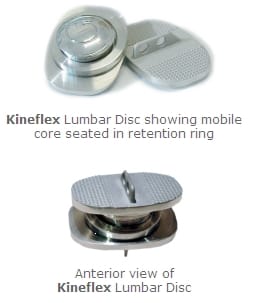 The artificial joint, which is made of a strong, durable cobalt chromium alloy (and should last longer than I do, or so I am told), maintains the natural movement of the back and that joint, whereas a fusion locks the joint up and grows the two bones together into one. In theory, the result is better overall, since a fusion transfers the load and movement (and the resulting wear and tear) to the adjacent joints. The artificial disc mimics the body's normal range of motion.
The things we tried that didn’t work
This all came to pass after repeated attempts at less-invasive therapy and surgical procedures. From medication to physical therapy, then on to antiinflammatory steroid injections (which is quite a hot topic these days) and a surgical procedure called microdiscectomy, the pros tried many different approaches (and I suffered through even more pain and troubles) before we eventually settled on the more significant surgery. And even then it was still a tough decision.
Looking back on it now, I really waited too long before pulling the trigger each step of the way. Too long to go to the doctor in the first place, too long to get the first steps of treatment, and too long to get to an orthopedic spine specialist. I was beyond miserable, barely able to get on my feet (and sometimes even unable to get up off the floor). I was quite literally in constant pain, and my mind and body had compensated – as the brain tends to do – by tuning out all but the worst of it from conscious awareness. But pain is still pain, and the lack of sleep and physical consequences of always compensating for it were just too great, and went on for too long. By the time I had the ADR surgery, it was well past time to do something.
The surgery
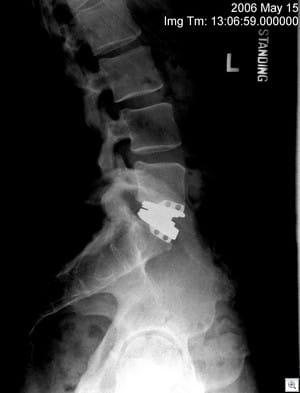 My doctor – Dr. Reginald Knight, whom I hear now practices medicine somewhere on the east coast – was awesome. I went up to Seattle and met with him. He evaluated me and determined surgery was the best remaining option in my case. He offered up the artificial disc medical trial as an alternative to fusion of the joint. In fact, it was a lottery-style selection process: I could have the surgery knowing that I would either get the Kineflex device or another brand of artificial disc, but I would not know which until after the surgery (since they were randomly and blindly assigned). Even the doctor didn't know which device would be implanted until I was already knocked out and on the surgery table.
It was a serious, heavy duty procedure, known as an anterior approach (good description here), which involved cutting me open below my belly button and moving all my guts and stuff out of the way in order to get access to my spine from the front. Then they cut the ligaments along the joint, removed the badly damaged disc (a shock-absorbing-like structure between the vertebrae) and replaced it with the artificial disc. That process consisted of cutting slots in the bones to anchor the device, spreading the joint out, and sliding the new artificial joint in place. Then they sewed me back up.
As I wrote at the time, the first few days were pretty rough. But quickly I started to heal and within a few weeks I was feeling better and better. Within an month and a half, I was travelling internationally and was well on the way to being “normal” again.
Life after the surgery
I wrote about my status a year later, and commented on how much better things had become. I had truly gotten my life back. Since that time, my back has only improved. I regularly ski and do literally anything I want. In fact, 99% of the time I forget I have the artificial disc at all. For a year or so after the surgery I would get some odd joint clunks and pops, but over time my body has adjusted and anymore it’s just part of me. Everything else seems to have aligned and adjusted.
When doing heavy-impact sports, such as skiing on icy or very hard surfaces, the jarring motion in my back can cause some discomfort and inflammation, so I have to watch out for that. But that’s more of an aggravation than a problem. I just have to remember that there’s no more shock absorber there – It’s all hard metal now. Once a joint is damaged as badly as mine was, you’ll never become 100% better I think, but I am consistently 90 to 95% like new, and that’s something I’m truly grateful for.
Common questions
There are a few things people ask me about regularly, so I’ll list those here with some answers.
Q: How do you deal with airports? Do you set off metal detectors or get into trouble on those new millimeter-wave scanners?
A: No problems at all. The metal is non-ferrous, so it doesn’t set off magnetic sensors, and the millimeter-wave scanners look at surface items, not into your body. So I’ve had no issues at all, not even once. And I fly commercially a lot.
Q: What restrictions did your doctor place on you, and for how long?
A: Now every patient will get specific instructions from his or her doctor, but mine were clear: My doc told me that I had missed out on enough life, and that I needed to follow some common sense rules postsurgery about not bending over or lifting anything for a couple weeks (mostly aimed I think at making sure my incision healed without tearing), but within a few weeks he told me it was time to get out and do whatever I wanted. If it was uncomfortable, I’d know not to go there. But, he said, no restrictions (literally) and that was it. I took him at his word and went to Germany for work, where I climbed the 400+ stone steps to the Heidelberg castle and walked miles and miles.
Q: Have you placed any restrictions on yourself?
A: Since the trip to Germany in 2006, I’ve done nothing but stay active with skiing, boating, jet skiing and a variety of other crazy, stupid activities. I did give up my motorcycle, however. I found that when I rode it I was thinking too much about what could happen to my back if I was in a motorcycle accident, rather being 100% focused on the driving. If i reinjured my back, fixing it would not be much of an option. I’d rather not take that chance, and the mental distraction was not exactly safe, either. So that’s the one thing I gave up. For now, anyhow. :)
Q: Are there dangers and side effect of the surgery?
A: All major surgery has risk. Anesthesia, bleeding problems – these are real any time someone goes under the knife. In particular this procedure has some risk related to blood vessel damage, since there are some key vessels to watch out for. In addition, there’s a risk of possible nerve damage that men especially should be aware of, since it can affect fertility and – well – let’s just call it “plumbing operations.” You can look it up if you like. Sometimes the damage is self-correcting over time, other times it’s permanent. Don’t avoid talking with your doctor about the possible issues there. While it’s rare and occurs in a very small percentage of cases, once a guy is affected he is 100% affected - and probability just isn’t relevant at that point.
Past writings for people who are interested
For people who are looking for information, or for anyone who cares to read back in time stalker-style (hah), I documented my surgery experience and early recovery, plus my one year results, here on this site:
- One year as a bionic man - how Kineflex gave me my life back
- Pictures of my bionic back - Kineflex disc
- Seven weeks after becoming bionic, my back is better than ever
- Walk a half a mile in my own shoes...
- Like being hit by a truck
- Surgery Wednesday - I'm about to become a bionic back recipient
- Going crazy, wanna ride along?
I also documented the mess of different things the docs tried, but which failed – much of the stuff that led up to the major surgery:
- Decisions, decisions: Right back to the back surgeons...
- Back to the back docs
- A light at the end of the pain tunnel?
- Going under the knife - It's time
- Stick a needle in my spine redux - surgical discectomy it is
- Stick Three Needles in My Spine – Again
- Stick a different needle in my spine - Part (uhhh) three? four?
- Stick a needle in my spine, part two
- Stick a needle in my spine

Member discussion: