Snoring and sleeping are two things that fall on a very short list of items that one cannot observe about oneself. Because of that, there's a strong tendency toward denial. It's a natural human tendency.
As I mentioned the other day, on Thursday night I went to a local sleep lab and spent the night there hooked up to a bunch of wires and stuff to find out what might be going on with me. I've been waking up tired for some time, feeling like I am getting little rest, etc. You can read more about that in the original post.
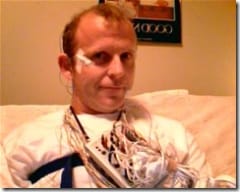 Anyhow, as you can sort of see in the bad-angle and bad-hair picture there on the right, I got a zillion wires, sensors and bands stuck to me (which it turns out was not as bad as people thought it would be) and fell asleep after spending the evening watching some TV and taking a Lunesta provided by the physician.
I remember waking up a few times throughout the night, which is pretty typical of me. Once the technician (who was very cool, by the way) had to come in and re-attach an airflow sensor that worked its way loose from my face, but overall I figured I slept as well as I do normally, or maybe even a little better than normal. I'll chalk that up to the pill.
The way the study worked was if you exhibit severe apnea within the first few hours they hook you up to a CPAP machine for the rest of the night. That didn't quite happen with me, so I was not woken up for that change of equipment. So in the morning I did the typical rationalization things and figured I was in the clear, no problems, must just be my head or something.
But when the doc came in the next morning (It's a great arrangement by the way - You fall asleep and the doctor shows up first thing so you don't have to come back for another office appointment), he showed me the data printouts and graphs from the night. Turns out I am waking up about 60 times an hour due to breathing problems - Apnea to be specific. People tend to be surprised by the facts since they can't observe it themselves, so when you can see your own stats and see that, hey look - I stopped breathing completely there for like 5 or 10 seconds and then make a loud snore and took a huge gasping set of breaths... My blood oxygen level dropped to like 80% in many cases. Well, let's just say the evidence speaks for itself.
I actually remembered waking up maybe 4 times or so because that's how many times I was awake long enough to form a memory and to become fully lucid, the doc explained. The other several hundred times were enough to be awake but not long enough to remember.
According to the doc I have at least moderate sleep apnea. Because I shifted off my back to sleep my side for most of the night, the apnea signs were probably not as bad as they would have been otherwise (it tends to be worse if you are positioned on your back, and during the time I was on my back the data shows it was in fact worse).
Apnea is simply the closing of your airway while you breathe during sleep. When you sleep your body relaxes, and that includes the muscles that shape the upper part of your airway (the part above the Adams apple is flexible, the rest is rigid). If the airway closes you get no air. If you get no air the brain is not happy. If the brain is not happy it wakes you up to move the muscles needed in order to open the airway. If this happens often enough, you never get long enough sleep to enter that REM phase, or deep sleep, which is needed to get "real" rest, or restorative sleep. And if that happens you have to deal with the problems of sleep deprivation. As mentioned earlier, you don't wake up long enough to remember anything, so it's hard to know when this is happening unless someone else sees it and knows what to look (and listen) for.
My doc said to think of the collapsing airway as being similar to the effect of trying to suck a milkshake through a straw: The straw collapses from the negative pressure and nothing can get through. The same is true for the throat for many people. That's really what snoring is - a collapsing or blocked airway.
So, long story short (too late), I will be going back to the sleep study place in a couple weeks for one more night, during which they'll hook me up to a CPAP machine. That stands for Continuous Positive Airway Pressure. It's a thing you wear on your face to blow some air into your airway to maintain enough positive pressure there to keep the airway open. I have spoken over the past few days will a surprisingly large number of people (some of whom commented here) who tell me they use a CPAP machine when they sleep and it's changed their lives. Well, worth a try then I guess. I have to admit I am not thrilled about the idea of wearing a mask when I sleep (it seems to me to be such a tied-down option) but I will try it if it might help. You never know.
More in a couple weeks, after the next phase of this whole deal is complete. Meanwhile if you ever need to do the sleep study thing, Oregon Sleep Associates is a good group of professional people and the sleep center is nice - not at all hospital like and easy to relax in. My doc's name is Scott Fromherz, MD and he's great at explaining things and answering questions. Definitely recommended if you find yourself needing a place to fulfill the need.

Member discussion: